


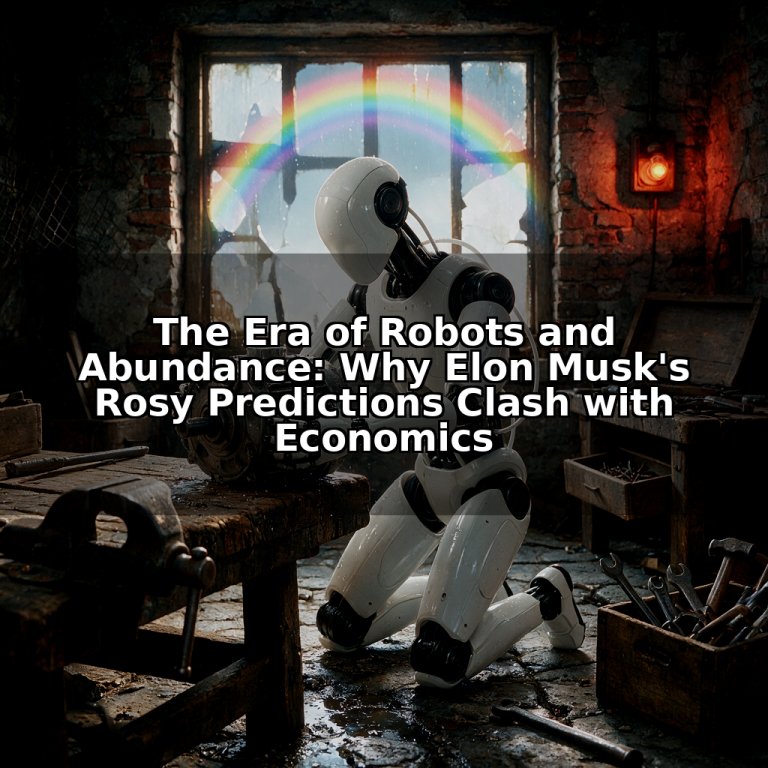
Tesla and SpaceX founder Elon Musk has repeatedly claimed that the advancement of advanced AI and mass-produced humanoid robots will lead humanity into an era of absolute material abundance. In his view, by 2036 machines will fully take over the production of goods and services, governments will be able to simply pay a universal basic income, and traditional money will lose its role against a backdrop of massive deflation. However, detailed economic and technical analysis suggests that the transition to a new economic order will be far harsher.
The Money Paradox and the Illusion of Deflation
Musk assumes that a sharp surge in supply will cause the prices of everything to collapse. But the classical equation of exchange shows that price stability depends not only on the volume of goods and the money supply, but also on the velocity of money. Constant basic income payments to households with no savings immediately accelerate capital turnover, as people spend regular checks immediately and in full.
Furthermore, goods are consumed and disappear, requiring continuous reproduction, while printed currency remains in the economy. Without aggressive tax extraction measures, constant money printing backed by anticipated future output growth risks triggering an inflation spike rather than the desired deflation.
Material Constraints: Energy, Copper, and Land
Robots can replace human physical labor, but they cannot eliminate the fundamental scarcity of natural resources:
- Energy Consumption: According to International Energy Agency (IEA) estimates, global electricity demand from data centers will double by 2030. The mass expansion of robots will require colossal amounts of generation.
- Raw Material Shortages: Copper supply is projected to fall short of global demand by a quarter by the mid-2030s, inevitably making manufacturing more expensive.
- Means of Production: A bipedal android does not replace quarry excavators, metallurgical plants, multi-billion-dollar lithography scanners, or arable land.
As a result, consumers will only see price drops on standardized industrial goods (gadgets, clothing), while essential goods—housing, land, food, and energy—will only become more expensive.
Historical Experience: How Past Revolutions Unfolded
Optimistic expectations often overlook the cost of transition. During the First Industrial Revolution in Britain, output grew for decades, but real wages and the living standards of working-class families only began to improve noticeably 50 to 80 years after mechanization started. Generations of workers who lost their craft faced destitution, never living to see the benefits of the eventual prosperity.
The concept of state handouts shifts social responsibility away from tech corporations: the costs of unemployment fall onto taxpayers, while the profits from automation accumulate with platform manufacturers.
Renting "Brains" and the Right to Repair
Purchasing a robot in the future is unlikely to turn an ordinary individual into a capital owner. Modern hardware systems depend on regular software updates, cloud-based neural network subscriptions, and proprietary service protocols. Consumers risk becoming heavily dependent on tech vendors that dictate operating costs and repair rules.
Instead of a sci-fi utopia, society risks arriving at a world of strict constraints, where automation reduces the cost of basic manufacturing, but core value concentrates in the hands of the owners of energy grids, computing power, raw materials, and exclusive decision-making rights.