


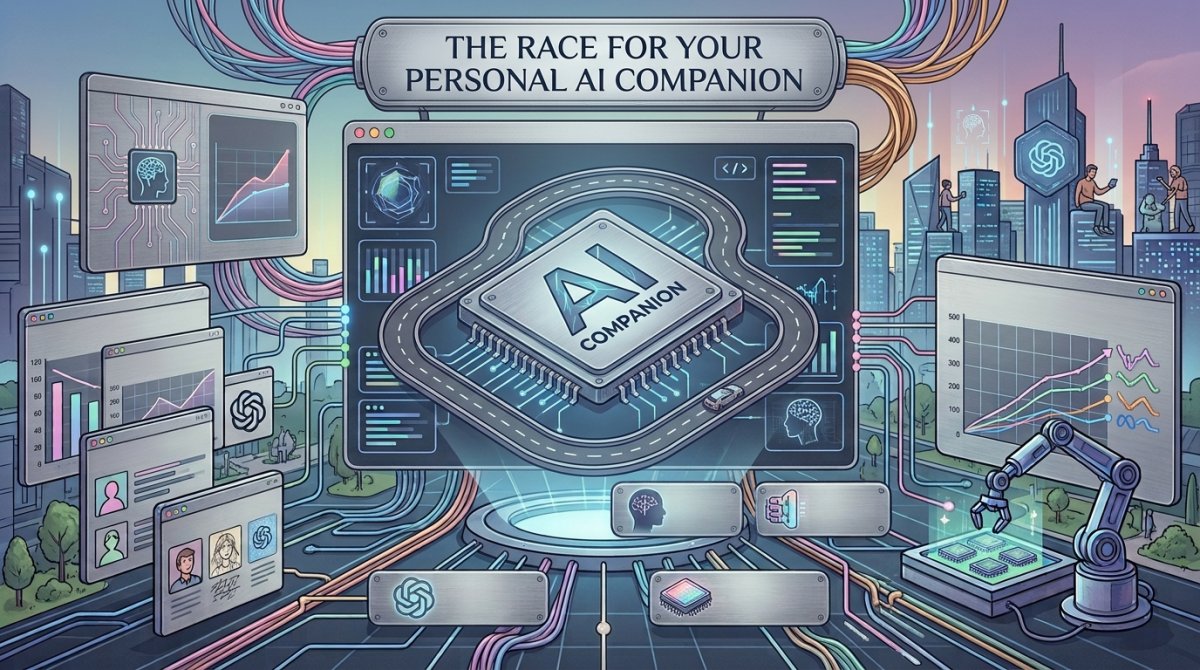
Rumors about a joint project between OpenAI and Jony Ive have fueled interest in AI-powered hardware solutions. The device is reported to be a compact, screenless portable gadget equipped with a suite of sensors, cameras, and microphones. However, the real intrigue lies not in the physical shape of a specific gadget, but in a broader paradigm shift: the industry is striving to bridge the gap between the capabilities of modern language models and outdated user interfaces.
Why Classic Interfaces No Longer Suit AI
Today, interaction with artificial intelligence remains largely reactive. Users must independently recognize a need, open an app, enter a text or voice prompt, and manually provide the system with all the necessary context.
A full-fledged AI companion implies a fundamentally different operating model. It continuously tracks background events in a user's life, stores key details in long-term memory, and takes initiative at the right moment without direct prompts—such as proactively warning about traffic jams or reminding users of forgotten items based on past conversations.
The Companion Formula: From Sci-Fi to Technical Requirements
The concept of a persistent assistant echoes the "jewel" device from Orson Scott Card's sci-fi novels, through which the protagonist interacted with an omnipresent intelligence. Today, this concept has evolved into a concrete set of requirements for personal AI:
constant readiness for interaction and natural language comprehension;
continuous awareness of the audiovisual environment;
maintenance of a unified persona and contextual memory over time;
direct access to digital services and the ability to execute tasks autonomously.
Finding the Right Form Factor: Earbuds and Smart Glasses
Creating an entirely new category of standalone AI devices from scratch carries significant risks, as demonstrated by the struggles of startups like Humane. It is far more practical to integrate assistant features into existing, familiar products that already provide standalone value.
Yandex is pursuing this direction with its "Dropsy" wireless earbuds featuring "My Memory" integration, which connects earbuds, smart speakers, and smart home devices. At the same time, traditional in-ear designs cause fatigue during prolonged use. Open-ear designs equipped with energy-efficient micro-cameras and neural processors look considerably more promising.
Experiments like the VueBuds prototype and leaked Apple demonstration materials showing prospective AirPods with cameras designed to feed context into the Visual Intelligence system demonstrate market momentum toward hybrid solutions: a familiar audio accessory is gradually becoming a primary sensory gateway for AI.
Distributed Architecture Instead of a Single Super-Gadget
A mature assistant does not need to gather all sensory data through a single device chassis. Users are already surrounded by an extensive sensor network: smartwatches monitor physiology and movement, connected cars track routes, computers capture work tasks, and smart home electronics monitor the living environment.
In this model, wearables act as "sensory organs," feeding data to compact local models. These local models filter out background noise, identify significant events, and invoke large cloud-based LLMs only when necessary. The critical engineering challenge here is algorithmic curation—the assistant must reliably distinguish valuable facts from ambient noise.
The Competitive Landscape: What Leading Players Bring to the Table
Major technology platforms are developing personal assistants tailored around their core competitive strengths:
OpenAI: relies on its leadership in foundational models and aims to develop proprietary hardware to avoid dependence on third-party operating systems.
Yandex: scales the Alice ecosystem by uniting physical wearables, smart home devices, and service infrastructure (ordering food, booking rides, and shopping via AI agents).
Meta: bets on Ray-Ban Meta smart glasses, leveraging the natural advantages of a first-person field of view.
Google: integrates Gemini deeply into the Android ecosystem while preparing audio glasses powered by Android XR.
Amazon: upgrades Alexa+, emphasizing deep smart home integration and consumer action automation.
Apple: leverages deep integration of the revamped Siri with its vast hardware fleet, system applications, and on-screen user context.
The Battle for the Ultimate Intermediary
The emergence of personal agents transforms how users interact with the digital space. Users will no longer need to switch manually between dozens of standalone apps—simply expressing an intent will suffice. The AI will determine which service to call, handle payment processing, and request confirmation only when necessary.
The company whose assistant establishes itself as the primary intermediary between user intent and downstream services will gain decisive strategic leverage over the entire digital economy.
The Need for Open Standards
As ecosystems evolve, demand will grow for cross-platform interoperability, similar to the Matter standard in the Internet of Things. Users are unlikely to tolerate being locked into hardware and assistant combinations from a single brand.
Early developments in this direction are already underway: tool integration protocols (such as MCP) and agent-to-agent (A2A) networking standards are gaining traction. In the future, devices could share sensor data through standardized protocols with whichever AI companion the user selects.
Memory as the Primary Platform Lock-In Factor
The most valuable and sensitive asset of any personal AI will be years of accumulated memory: relationship histories, business agreements, preferences, and personal routines. This will create an unprecedented level of customer retention within platform ecosystems.
Consequently, issues of security and digital sovereignty will take center stage: who owns accumulated memories, how can they be exported when switching providers, and how can the deletion of confidential data be guaranteed. Ultimately, the winners will not simply be the makers of the fastest gadgets or the largest neural networks, but those who build a trustworthy, secure, and genuinely helpful personal layer between users and the digital world.