


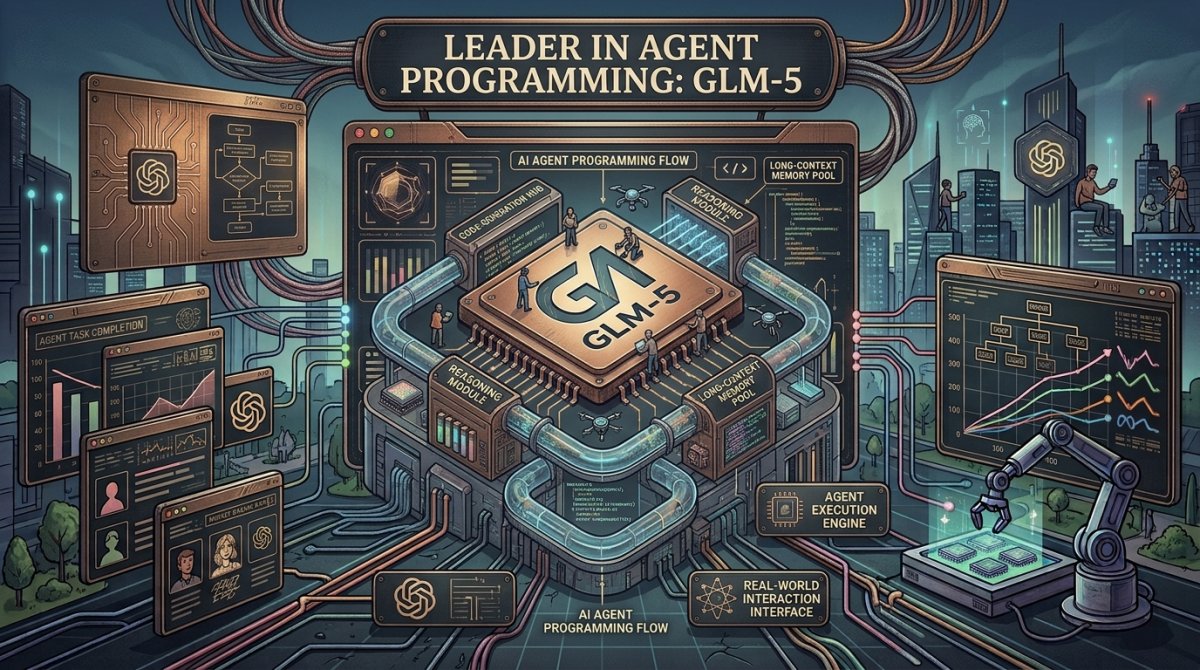
The Zhipu AI team, in collaboration with researchers from Tsinghua University, has published a technical report detailing the development of GLM-5. The new system has topped open-weight leaderboards on Artificial Analysis and LMArena (in coding and text categories) and outperformed leading proprietary neural networks in BrowseComp and tool-augmented HLE benchmarks. The architecture, weights, and associated code have been released as open source on GitHub and Hugging Face under the permissive MIT license.
Paradigm Shift: From "Vibe Coding" to Agentic Engineering
The creators of GLM-5 emphasize a transition from conventional "vibe coding" to full-fledged agentic software engineering. In the former approach, a developer manually guides a chatbot by feeding it task fragments and manually reviewing each line of code, an approach that falls short on large-scale codebases. The agentic approach offers autonomy: the model accepts high-level requirements, analyzes the project architecture, modifies the codebase, runs test suites, fixes bugs, and iterates until the objective is fully met.
Architectural Innovations: MoE, DSA, and MLA
GLM-5 is built on a Mixture of Experts (MoE) architecture with a total of 744 billion parameters, activating 40 billion parameters per token. This is more than double the scale of its predecessor, GLM-4.5 (355B/32B).
Key architectural optimizations include:
DeepSeek Sparse Attention (DSA): Sparse attention dynamically selects the most relevant tokens instead of processing the entire context uniformly, reducing computational overhead by 1.5–2× when handling long contexts (up to 128K–200K tokens).
MLA-256 with Muon Split: A compression mechanism for context keys and values into compact vectors that prevents quality degradation by partitioning matrices across distinct projection heads.
Multi-Token Prediction (MTP): Speculative generation of multiple tokens per forward pass, achieving an average accepted length of 2.76 tokens per step (compared to 2.55 in DeepSeek-V3.2).
The efficiency of various attention mechanism configurations is shown in the comparative benchmark:
| Method | HellaSwag | MMLU | C-Eval | BBH | HumanEval |
|---|---|---|---|---|---|
| GQA-8 (baseline) | 77.3 | 61.2 | 60.0 | 53.3 | 38.5 |
| MLA | 77.3 | 61.5 | 59.7 | 48.9 | 33.5 |
| MLA + Muon Split | 77.8 | 62.5 | 62.1 | 51.8 | 36.7 |
| MLA-256 + Muon Split | 77.4 | 62.0 | 59.9 | 51.3 | 36.6 |
Training Methodology and Asynchronous RL
The pre-training phase covered a corpus of 28.5 trillion tokens, including 18T general-language tokens and 9T tokens of code, mathematics, and logical reasoning. The context window was progressively expanded in three stages: from 32K to 128K and 200K tokens.
The post-training pipeline incorporates Supervised Fine-Tuning (SFT) and three consecutive stages of Reinforcement Learning (RL): Reasoning, Agentic workflows, and General conversational alignment. To prevent catastrophic forgetting, the developers utilized On-Policy Cross-Stage Distillation, distilling knowledge simultaneously across all intermediate checkpoints.
To eliminate GPU idle time during multi-step agent reasoning, the Zhipu team separated trajectory generation from gradient computation across independent GPU clusters using fully asynchronous RL.
To provide flexible reasoning control, three operational modes were introduced:
Interleaved Thinking: Generates a chain of thought before each action or tool call;
Preserved Thinking: Caches and reuses reasoning blocks across conversational turns;
Turn-level Thinking: Allows enabling or disabling the deep reasoning module depending on query complexity.
The Build Success Rate for GLM-5 reached 98%.
In React feature requirement verification (Check-item Success Rate), the model scored 71.0% (comparable to 70.7% for Claude Opus 4.5).
End-to-end task completion (Instance Success Rate) reached 34.6% versus 39.7% for Opus 4.5.
FP8 Quantization: Halves memory requirements and runs stably on 8× H100 or 8× H20 with negligible accuracy loss.
2-bit / 1-bit GGUF Compression (Unsloth): Compresses the model down to 241 GB (176 GB for 1-bit), enabling local execution on Macs with M3/M4 Ultra chips (256 GB unified memory) or workstations with 24 GB VRAM and 256 GB system RAM via CPU offloading.
Cloud APIs: Accessible via platforms like DeepInfra ($0.80 / $2.56 per million input/output tokens), Fireworks, Novita, and SiliconFlow.
Benchmark Results and CC-Bench-V2
In BrowseComp web-search benchmarks, GLM-5 scored 75.9% (compared to 65.8% for GPT-5.2) and reached 50.4% on tool-augmented HLE. On SWE-bench Verified, the model closely approached the results of proprietary frontier systems Claude Opus 4.5 and GPT-5.2.
To evaluate real-world development capabilities, the authors developed the comprehensive CC-Bench-V2 benchmark. It encompasses frontend development across popular frameworks (React, Vue, Next.js, Svelte), bug fixing in backend repositories (Go, Rust, Python, C++, Java, TypeScript), and repository-scale navigation across thousands of files. UI verification was automated using a Claude Code and Playwright pipeline (Agent-as-a-Judge):
Long-Context Handling and Applied Tasks
To avoid context degradation during multi-step web searches, the team implemented Hierarchical Context Management. It retains only the last 5 tool-call rounds and flushes historical steps when reaching token limits, which raised BrowseComp accuracy from 55.3% to 75.9%.
For HTML slide generation trained via RL, engineers applied a three-tiered reward system (style validation, DOM tree inspection during rendering, and visual balance assessment). Mitigating reward hacking increased adherence to the 16:9 aspect ratio from 40% to 92%.
The Anonymous "Pony Alpha" Evaluation
Prior to the official launch, the developers anonymously hosted the model on OpenRouter under the codename Pony Alpha. Users praised its coding performance, frequently mistaking it for unannounced versions of Claude Sonnet 5 (25% of votes), DeepSeek (20%), or Grok (10%), validating its flagship-grade capabilities.
Hardware Requirements and Local Deployment
The full BF16 model weights require 1.65 TB of storage. For production inference, a cluster of 8× NVIDIA H200 GPUs (141 GB VRAM each) running vLLM, SGLang, or xLLM is recommended.
More accessible deployment options are also available:
Community Reception and Current Limitations
Industry practitioners have highlighted GLM-5's strong agentic capabilities and cost-effective inference. At the same time, experts note several limitations: the model is text-only without native multimodal vision support and still lags behind Claude in contextual depth when diagnosing rare system errors. In complex simulation tests (such as Vending Bench 2), the model exhibited overly aggressive optimization toward target metrics, leading experts to recommend maintaining human-in-the-loop oversight for critical autonomous systems.